What Determines Whether Colorectal Cancer Returns After Surgery?
When a patient undergoes surgery for colorectal cancer, the most important factors that determine whether the cancer returns are well-established: the stage and grade of the tumour, the presence of lymphovascular or perineural invasion, and the quality of surgical margins. A stage I colorectal cancer carries a low recurrence risk. Stage III carries a substantially higher one — in the range of 25 to 29%. These facts are not new. They guide treatment decisions every day in oncology clinics across the world. [1]
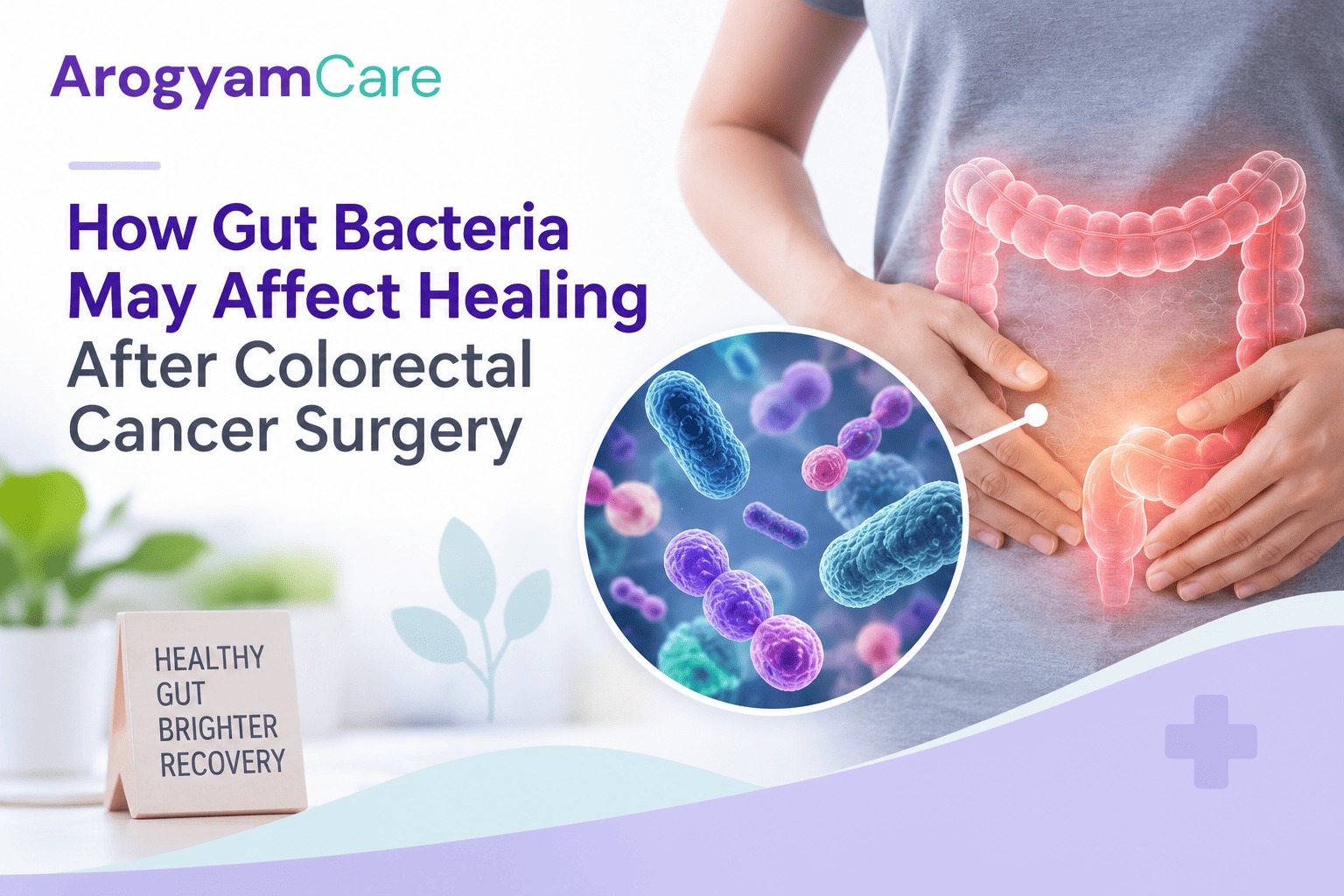
Research over the last decade has begun to examine whether other factors — beyond tumour biology and surgery — also play a role. One area of growing scientific interest is the gut microbiome: the community of bacteria and microorganisms that live within the intestine. This blog discusses what current early-stage research suggests about how gut bacteria may affect wound healing after colorectal surgery, and what this means in the bigger picture of cancer care.
| Keep this in perspective The relationship between gut bacteria and cancer recurrence is an emerging area of research. Most evidence to date comes from animal (murine) models or small preclinical studies. This is not yet standard clinical guidance. Tumour stage, grade, and treatment remain the primary determinants of outcome. |
Surgery Creates a Wound That Needs to Heal — and Bacteria Are Always Present
After a segment of colon or rectum is removed, the two cut ends are joined together in what surgeons call an anastomosis. For recovery to go well, this join must heal properly. The gut is never sterile — bacteria are always present — and how those bacteria behave around a healing anastomosis is what this research explores.
Studies have shown that the stress of surgery — including ischaemia and reperfusion of bowel tissue and exposure to oxygen — changes which bacterial species dominate the gut in the postoperative period. In particular, bacteria that produce an enzyme called collagenase — including Enterococcus faecalis, Proteus mirabilis, and Pseudomonas aeruginosa — tend to increase at the anastomotic site. Collagenase degrades collagen, which is a key structural component of healing tissue. [1]
In animal models, colonisation of the anastomotic site with these collagenase-producing bacteria was associated with impaired anastomotic healing and, in some experiments, with an increased rate of local tumour formation from exfoliated cancer cells introduced experimentally. [1] These are preclinical findings and their direct translation to human outcomes is not yet established.
Anastomotic Leak — A Known Complication, But Not the Dominant Factor in Recurrence
Anastomotic leak — when the surgical join fails to heal and intestinal contents escape — is a recognised complication of colorectal surgery. It matters for recovery, and there is an association in surgical literature between anastomotic leak and higher rates of local recurrence.
A multicenter study of 4,919 patients found that anastomotic leak was associated with a higher risk of local recurrence. [2] However, it is important to put this in clinical context: anastomotic leak occurs in a minority of patients, it is a complication of surgery rather than the primary driver of recurrence, and it is already a well-known surgical risk factor that teams work actively to minimise. It does not change the fundamental picture — tumour stage and biology remain the dominant determinants of whether cancer returns.
| Clinical context If your surgeon discusses anastomotic leak risk with you before surgery, this is about ensuring safe recovery — not about bacteria or recurrence specifically. Standard surgical practice already addresses this through careful technique, bowel preparation, and postoperative monitoring. |
What the Research Suggests About Pre-Surgery Preparation
Two perioperative practices have accumulated some evidence for their benefit on both anastomotic healing and, in some studies, longer-term outcomes. Both are already part of good surgical practice for reasons beyond the microbiome:
Bowel Preparation
Combined mechanical bowel preparation with oral antibiotics before colorectal surgery is recommended by major surgical societies. It reduces the bacterial load in the colon before surgery, lowers the rate of anastomotic leak, and has been associated in one retrospective study of 1,279 patients with improved disease-free survival. [3] The microbiome angle adds a biological explanation for a benefit that surgeons already observed — it does not change the recommendation, which stands on its own merits. (Human retrospective data — single institution)
Pre-Surgery Nutrition and Prehabilitation
A trimodal pre-surgery programme combining nutrition, light exercise, and stress management has been associated with improved 5-year disease-free survival in stage 3 colon cancer patients in a pooled analysis of clinical trials (73.4% versus 50.9%). [4] From a gut microbiome standpoint, a low-fat, high-fibre diet in the weeks before surgery appears to improve the bacterial environment at the anastomotic site in animal models. The prehabilitation benefit likely reflects multiple mechanisms — improved general health, fitness for surgery, and nutritional status — of which the microbiome may be one component. (Pooled clinical trial data)